2026 Top Dynamic Checkweigher Trends and Innovations?
In the rapidly evolving world of packaging and production, the Dynamic Checkweigher remains at the forefront of innovation. Industry expert John Smith, a leader in this field, once remarked, “Dynamic Checkweighers play a crucial role in enhancing product quality and operational efficiency.” As we approach 2026, trends and technologies within this sector are intensifying.
Dynamic Checkweighers are not just about weighing products. They provide invaluable data that can help streamline processes. This equipment ensures that every package meets the required specifications, reducing waste and errors. Yet, the integration of advanced technology also presents challenges. Companies must balance automation with human oversight to maintain precision. Pushing boundaries while ensuring reliability is critical.
While innovations are promising, some firms grapple with the cost of implementation. It's essential to weigh the return on investment. Adopting the latest Dynamic Checkweigher might seem beneficial, but companies must analyze all angles before proceeding. Striving for the latest technology is essential, but it should not come at the expense of operational integrity.

Top Trends in Dynamic Checkweighers for 2026: An Overview
Dynamic checkweighers are evolving rapidly in 2026. Companies are prioritizing high-precision weighing systems. These innovations improve efficiency and reduce errors in production lines. Enhanced connectivity is another trend. Machines are now easily integrated with IoT systems. This leads to real-time data monitoring. Operators gain immediate insights into weight discrepancies, allowing for quicker adjustments.
Sustainability is a key focus. Designs are shifting towards energy-efficient technologies. Many manufacturers are exploring greener materials for construction. Not all solutions are perfect. Some machines may struggle with certain product shapes. This could lead to inconsistent readings. Continuous development is essential to address these issues. Operators must stay alert to potential limitations.
User-friendly interfaces are a growing trend. Simple controls can minimize training time for staff. However, some advanced features may overcomplicate user experience. Balancing simplicity and functionality is crucial. Accurate and accessible data presentation is necessary. It helps teams make informed decisions on the fly. As dynamic checkweighers adapt, the industry faces both opportunities and challenges.
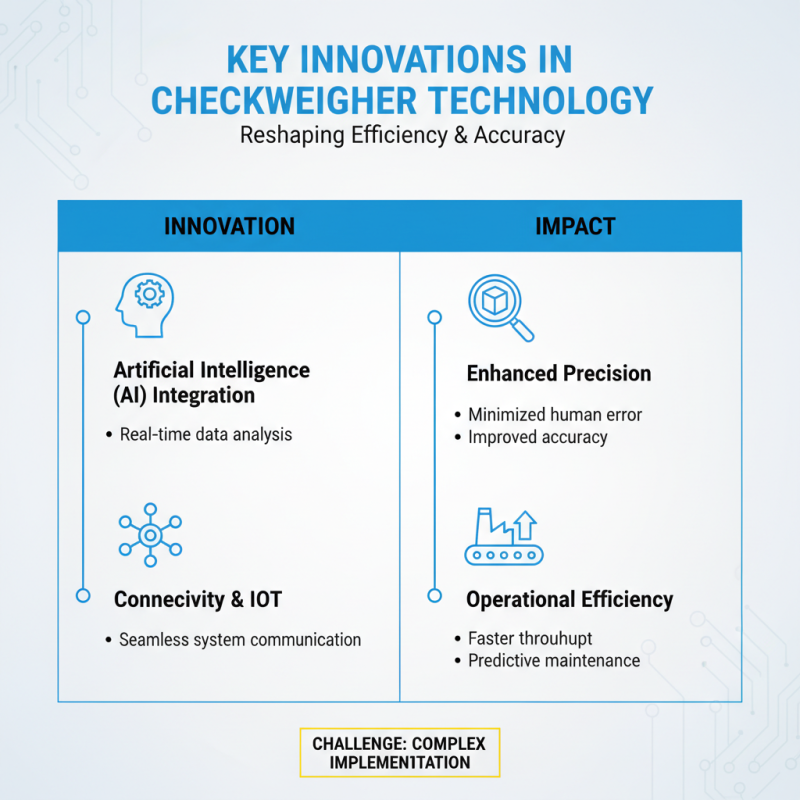
Key Innovations in Checkweigher Technology and Their Impact
The world of checkweighers is evolving rapidly. Innovations are reshaping how businesses weigh and inspect products. These changes significantly affect efficiency and accuracy. One notable trend is the integration of artificial intelligence. AI enhances precision by analyzing data in real-time. This technology minimizes human error, but it also raises challenges in implementation.
Another key innovation involves the use of advanced sensors. These sensors can detect not only weight discrepancies but also product integrity. They help ensure that each item meets quality standards. However, the complexity of these systems can lead to maintenance issues. Businesses must balance advanced features with user-friendliness.
Moreover, automation continues to play a crucial role. Automated checkweighers speed up production lines. They can handle large volumes efficiently, but this reliance on machines may pose risks. For instance, a malfunction could halt operations, leading to delays. Continuous training and adaptive strategies are essential for managing these innovations. The future of checkweighers holds great promise, yet it requires careful navigation of its challenges.
Market Growth Projections for Dynamic Checkweighers by 2026
The dynamic checkweighers market is on an upward trajectory, with a projected growth rate of around 8.5% annually through 2026. This increase is driven by the rising demand for precision in packaging processes across various industries. The food and beverage sector is particularly influential, accounting for nearly 40% of the market share. Consistent accuracy is vital for ensuring product quality and compliance with regulations.
Recent data indicates that automation in manufacturing will further propel market expansion. Companies are increasingly investing in advanced checkweighing solutions to enhance efficiency. The integration of smart technologies is a notable trend. Devices equipped with IoT capabilities can provide real-time data analytics. However, some businesses still struggle with the transition to fully automated systems. They face challenges in training staff and adapting existing processes.
Market innovation is also a focus area. Manufacturers are exploring more compact designs without sacrificing performance. Innovations in software allow for easier data interpretation and compliance tracking. While challenges remain, such as the high initial investment, the overall outlook appears positive. As industries seek to improve their operational reliability, dynamic checkweighers will play a critical role in achieving those goals by 2026.
Integration of AI and Automation in Dynamic Checkweighers
The integration of AI and automation in dynamic checkweighers is transforming the packaging and production industries. These advanced systems can now achieve up to a 99% accuracy rate in weight measurements. This is a significant improvement over traditional models. AI algorithms help identify weight shifts and inconsistencies in real-time. Manufacturers can reduce waste and minimize errors, increasing operational efficiency.
Recent industry reports highlight that 70% of companies plan to invest in AI-driven technologies by 2026. This surge in investment indicates a shift towards smarter manufacturing processes. Automation allows for quicker adjustments based on AI insights. Yet, challenges remain. Not all products are suited for automated checkweighing. The variability in product size and shape can complicate measurement accuracy.
Many businesses are still adapting to these technologies. Implementing AI requires ongoing learning and adaptation. Some staff may not easily transition to automated systems. Concerns about job displacement also arise. Ultimately, utilizing AI in dynamic checkweighers shows promising potential, but real-world applications need careful consideration. Continuous evaluation of these innovations is essential for ensuring they meet evolving production needs.
2026 Top Dynamic Checkweigher Trends and Innovations
Sustainability Trends Shaping the Dynamic Checkweigher Industry
The dynamic checkweigher industry is experiencing significant shifts driven by sustainability trends. In 2022, the global checkweigher market was valued at approximately $500 million, and this is expected to grow by 5% annually. Manufacturers are increasingly focused on eco-friendly solutions, minimizing waste, and reducing energy consumption. This shift is crucial as industries strive to lower their carbon footprints.
Recent data suggests that about 30% of companies prioritize sustainable practices in their production lines. However, some still grapple with the balance between efficiency and environmental responsibility. Innovative designs, such as modular checkweighers, allow for easy upgrades and parts replacement, reducing waste. More companies are also considering software solutions to optimize operations, which helps save energy.
Consumer awareness of sustainability is changing purchasing decisions. A report shows that over 60% of consumers prefer products from companies with strong environmental commitments. Yet, challenges remain. Integration of sustainable practices into established systems can be complex and costly. Finding a balance is essential for future growth. The journey is not linear; ongoing reflection and adaptation will be necessary as these trends evolve. Each step forward needs careful consideration of both environmental impact and operational efficiency.